Science Crossword Puzzles
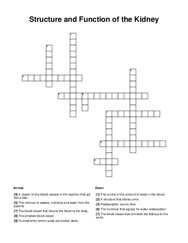
Structure and Function of the Kidney
osmoregulation: the control of the amount of water in the blood. , proximal tubule: reabsorption occurs here, bladder: a structure that stores urine. , …
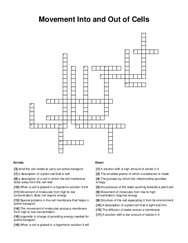
Movement Into and Out of Cells
diffusion : the movement of molecules across a membrane from high to low concentration, flaccid : a description of a plant cell that is soft, mitochondria : …
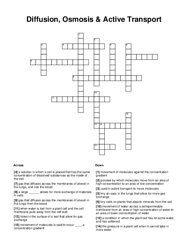
Diffusion, Osmosis & Active Transport
diffusion : process by which molecules move from an area of high concentration to an area of low concentration, osmosis : movement of water across a …
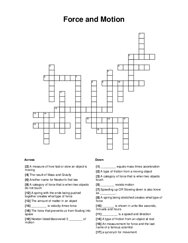
Force and Motion
newton: an measurement for force and the last name of a famous scientist, extension: a spring being stretched creates what type of force, motion: a synonym for …
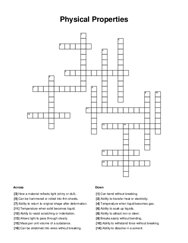
Physical Properties
hardness : ability to resist scratching or indentation., density : mass per unit volume of a substance., elasticity : ability to return to original shape after …
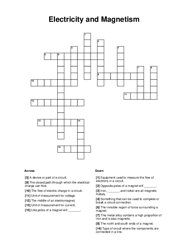
Electricity and Magnetism
magnetic field: the invisible region of force surrounding a magnet. , current: the flow of electric charge in a circuit., voltmeter: equipment used to measure …
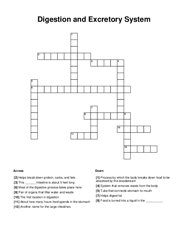
Digestion and Excretory System
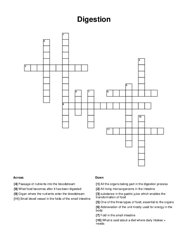
small intestines : most of the digestive process takes place here, kidneys : pair of organs that filter water and waste, mouth : the first location in …
National Lab Week
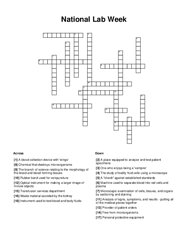
laboratory : a place equipped to analyze and test patient specimens, inspection : a "check" against established standards, histology : microscopic …
Circulatory and Excretory Systems
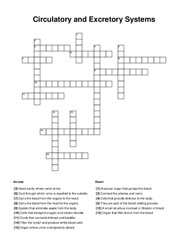
urethra: duct through which urine is expelled to the outside., excretory: system that eliminate waste from the body , ureters: ducts that connects kidneys and …
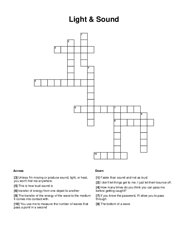
Light & Sound
light: faster than sound and not as loud , reflect: i don't let things get to me. i just let them bounce off., absorb: the transfer of the energy of the …
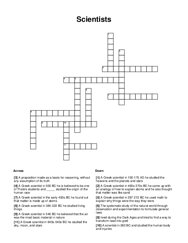
Scientists
thales : a greek scientist in 640s-540s bc he studied the sky, moon, and stars, anaximander : a greek scientist in 500 bc he is believed to be one of …
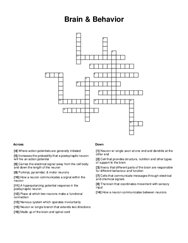
Brain & Behavior
cns: made up of the brain and spinal cord, synapse: place at which two neurons make a functional connection, excitatory: increases the probability that a …